Fuzzybear shows how meme NFTs are moving from jokes to playable culture
The bigger shift hiding inside the bear
Fuzzybear looks funny on the surface, and that is part of the point. A bear, a meme coin, NFT collections, trading cards, reverse-name jokes and XRP Ledger lore can look like pure internet madness if you only glance at it. But the real story is bigger than one project. It shows how meme NFT culture is changing. The old version of NFT hype was mostly about profile pictures, floor prices and fast-moving speculation. The newer version is trying to turn memes into worlds. That means lore, games, physical collectibles, community rituals and stories people can repeat. Fuzzybear is interesting because it sits right in that shift. It takes an old on-chain moment, wraps it in meme culture, then stretches it across tokens, NFTs and trading cards. That does not make it risk-free. It does not prove long-term value. But it does make it worth watching as a cultural signal, especially inside the XRP community.
The old way was simple speculation
The old NFT playbook was easy to understand. A collection launched, people minted, the floor moved, and the crowd tried to guess whether attention would grow or disappear. Some projects built real communities, but plenty were just quick-fire speculation with art attached. The problem is that a picture alone is hard to defend once the attention fades. If the only reason people care is because the price might rise, the community becomes fragile. One bad week can turn excitement into silence. This is why more projects are trying to add something else. They want lore. They want participation. They want physical objects, games, quests, memes, burn mechanics, holder benefits and a reason for people to keep talking after mint day. That is where Fuzzybear becomes more than a bear picture. It is trying to turn an old ledger story into a living meme world.
The origin story gives it a stronger hook
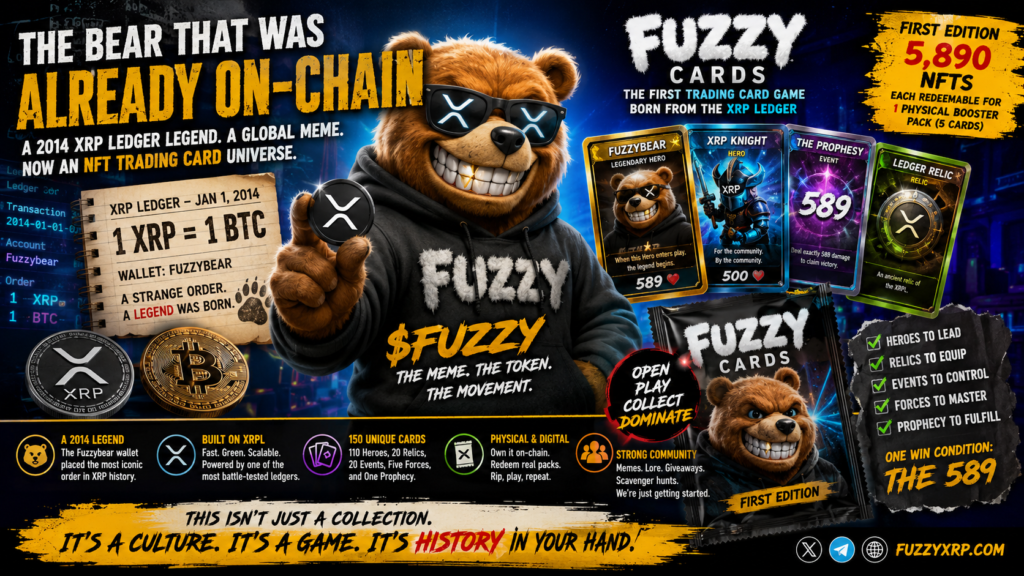
The strongest part of the Fuzzybear story is the origin myth. The public transaction record shows that on 1 January 2014, an XRP Ledger account named Fuzzybear placed an OfferCreate buy order involving 1 XRP and 1 BTC. That kind of strange, old, on-chain moment is exactly the sort of thing crypto culture loves because it feels like a fossil from the early days. It is not just a logo somebody invented last week. It is a piece of ledger history that can be retold, exaggerated, joked about and turned into a symbol. What this really means is simple: Fuzzybear has a story before it has a product. In meme culture, that matters. The story gives the community something to point at and say, “This was already there.” That line is powerful because it makes the project feel discovered rather than manufactured.
The project turns ledger lore into a meme system
The public Fuzzybear site presents $FUZZY as an XRPL meme coin created in commemoration of the Fuzzybear ledger legend. It also points to meme tools, NFTs, Telegram, X, XRPL explorers and DEX links, which shows the project is not just relying on one asset type. It is building a wider culture loop around the meme. That loop matters because meme projects live or die on repetition. People need things to share, argue about, collect, remix and explain to newcomers. The bear gives them the face. The old transaction gives them the myth. The meme bank gives them the social fuel. The NFT collections give them badges. The trading cards give them a reason to keep the story moving. The important part is that none of this should be treated as proof of financial success. It is proof of community design. That is different, but still meaningful.
Fuzzycards changes the shape of the story
Fuzzycards is where the idea becomes more interesting. The Fuzzycards site describes FUZZY TCG as “the first trading card game born from the XRP Ledger” and presents it as a 150-card first edition with 110 Heroes, 20 Relics, 20 Events, Five Forces and one prophecy. It also says every card is numbered from 1/150 to 150/150 and carries lore and abilities derived from the XRP Ledger. That matters because cards are easier for normal people to understand than tokens. A card has a name, a role, a rarity and a place in a game. A booster pack has suspense. A physical card gives the digital story something you can hold in your hand. The real story is not that a crypto project made cards. The real story is that the project is using cards to slow the meme down and make it collectible.
The physical pack angle gives it old-school collector energy
The Fuzzycards first edition page describes 5,890 booster packs, with each NFT redeemable for one physical booster pack containing five cards. It also describes 45 unique card designs across five rarity tiers and 2,356 holographic cards across a total set of 29,450 cards. That kind of structure speaks directly to collector psychology. People understand packs. They understand rare pulls. They understand the feeling of opening something and hoping for the card that everyone else wants. That sounds simple, but the plain-English point is important. Physical cards create a different emotional connection from a token sitting in a wallet. They add anticipation, scarcity and ritual. They can also make the project easier to explain to someone who does not live inside crypto all day.
The game mechanics matter because they create use beyond holding
The game rules describe a structure where players deploy Heroes, equip Relics and use Events to reduce the opponent’s Life to zero. Cards belong to Forces, turns move through phases, and one of the special win paths is “The 589,” where a player must deal exactly 589 total damage in a single game. This is smart community design because it turns inside jokes into mechanics. The number becomes more than a meme. It becomes part of play. That does not mean the game will automatically gain a large player base. Trading card games are hard to build, balance and sustain. But it does give the project a stronger foundation than a static collection alone. If people can play, trade, open, collect and talk, the culture has more ways to stay alive.
XRPL gives the project a native home
The XRP Ledger is not new to tokens or NFTs. Its official documentation says the ledger natively supports NFTs, which can represent ownership of unique physical, non-physical or digital goods, and that users can mint, hold, buy, sell and burn NFTs. It also has a long-running decentralised exchange structure where offers can trade XRP and tokens. That matters because Fuzzybear is not building on a blank platform. It is using existing XRPL rails, marketplace culture and community identity. The project’s appeal is tied closely to that home. For XRP supporters, the chain itself is part of the story. For outsiders, that may be harder to understand. The project is not trying to be a neutral internet meme. It is very much an XRPL-native meme with XRPL-native language.
The opportunity is culture, not guaranteed price
The opportunity here is not something as simple as “this will pump.” That would be lazy and dangerous. The better way to read Fuzzybear is as a case study in cultural packaging. A strong meme project needs a symbol, a story, a social loop, a reason to return and a reason to bring other people in. Fuzzybear has several of those pieces. It has the bear. It has the old transaction. It has XRP community lore. It has NFTs. It has physical packs. It has game mechanics. It has enough oddness to be memorable. But none of that removes risk. Crypto collectibles can be thinly traded. Meme coins can move violently. Communities can lose attention. Physical redemption systems can create operational pressure. The bottom line is that culture can create demand, but it cannot remove market risk.
The risk is that meme worlds are hard to maintain
The hard part for any meme NFT project is not launching attention. It is keeping attention once the first wave passes. A meme can explode quickly, but it can also become old quickly. A trading card game can create depth, but it also creates expectations. Players want rules that work. Collectors want fair distribution. Holders want communication. New buyers want clarity. If the story becomes too confusing, outsiders will not enter. If it becomes too financial, it can lose the fun. If it becomes too jokey, serious collectors may ignore it. This is where things change from meme-making to community management. Fuzzybear’s challenge is to keep the weirdness that makes it special while still giving people enough structure to care over time.
The benefit is that simple stories travel faster
The reason this project has FOMO-style story potential is that the basic version is easy to repeat. An old XRPL wallet called Fuzzybear placed a strange 1 XRP for 1 BTC order. Years later, people turned that bear into a meme coin, NFTs and a card game. That is clean. It has a beginning, a strange event, a resurrection and a new chapter. Many crypto projects struggle because they require a lecture before anyone understands them. This one can be explained like a campfire story. The important part is keeping it grounded. The old transaction is real. The prophecy language is cultural framing. The collectibles are project products. The future value is unknown. When those lines stay clear, the story becomes much stronger.
The unanswered questions are still important
There are still big questions that matter. Can Fuzzycards turn from a collectible idea into a game people actually play? Can physical card delivery and redemption scale cleanly? Can the community grow beyond XRP insiders? Can the meme stay funny without becoming repetitive? Can the NFT collections remain meaningful if the broader market cools? These are not small details. They are the difference between a moment and a long-running culture brand. The project has ingredients that are interesting, but ingredients are not the same as a finished meal. The next stage is execution. If the team and community can turn lore into repeatable participation, the project becomes more than a meme. If not, it risks becoming another bright crypto story that people remember for a season and then move past.
The bigger lesson for meme NFTs
The bigger lesson is that meme NFTs are moving toward world-building. People do not just want a picture anymore. They want a reason to belong. They want a story that makes them feel early. They want rituals, drops, games, physical items, memes and language that outsiders slowly learn. This is not only happening with Fuzzybear. It is part of a wider shift across internet-native culture. The strongest communities are becoming small media worlds. They sell objects, but they also sell identity. They give people something to repeat and something to defend. That is why Fuzzybear is worth studying. It shows how a strange old blockchain moment can become the seed for a modern collector economy.
The final takeaway
Fuzzybear works as a FOMO style story because it has what many meme projects lack, a clear myth, a native community, a physical collectible layer and a game-shaped future. That does not mean it is safe. It does not mean it will become valuable. It does not mean every claim around it should be accepted without checking. But it does mean the project understands something important about internet culture. People do not only chase assets. They chase stories they can join before everyone else understands them. The bear was already on-chain. Now the question is whether the community can turn that old signal into something that lasts.