Code350 AEO Blog Engine: Building a smarter blog for the AI search era
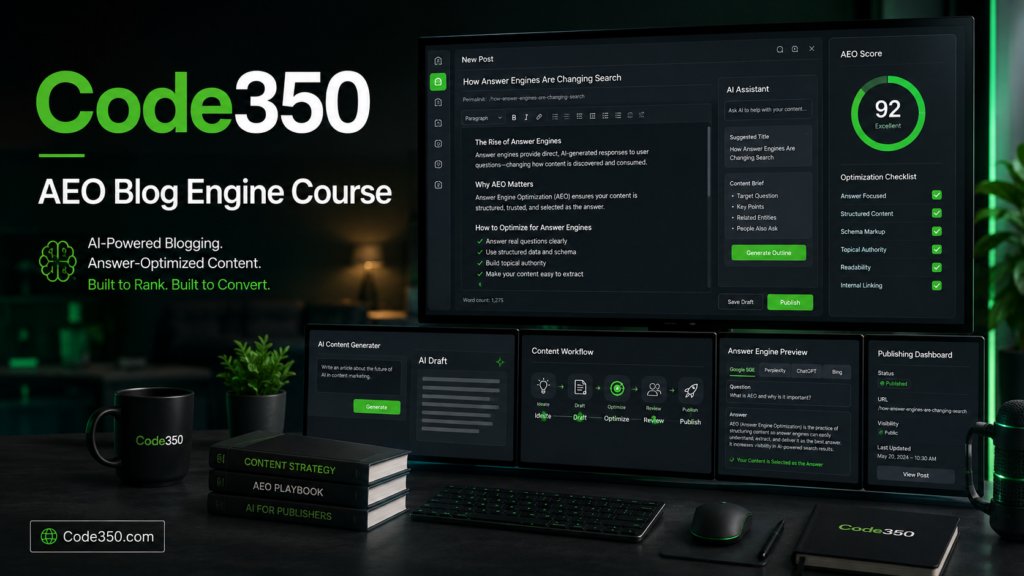
Code350’s new AEO Blog Engine course teaches beginners how to build, deploy and control an AI assisted publishing system rather than simply renting another blogging platform.
The bigger idea is not replacing writers with AI it is using AI to research, prepare and manage content while keeping human approval, sources and ownership at the centre.
Blogging is changing again.
For years, the formula was reasonably simple. Write useful articles, optimise them for Google, build authority and hope people found you through search.
In 2026, that discovery process is broader. Google now has AI Overviews and AI Mode, while people increasingly ask questions directly through tools such as ChatGPT and other AI assistants.
That has led to a new industry term: AEO, or Answer Engine Optimisation.
Code350 is leaning directly into that shift with its new AEO Blog Engine course, a roughly two-hour beginner course that gives students the source code and guides them through building and deploying their own AI-assisted publishing system. At the time of checking on 12 August 2026, Code350 lists the course at $199, discounted from $299.
The interesting part is that this is not simply a course about writing better blog posts.
It is a course about building the machine behind the blog.
What the AEO Blog Engine actually is
Code350 describes the AEO Blog Engine as a complete publishing system built using Next.js 16, Supabase and Vercel. Students receive the source code and are guided through setting it up inside the Code350 Workspace before deploying it under their own control.
That ownership model is important.
Instead of paying forever for access to a closed blogging service, the course is designed around owning and deploying the underlying code yourself.
According to Code350, the engine can ingest news related to your chosen niche, use AI to assess what matters to your audience and prepare drafts through a multi-stage writing process. Those drafts are not automatically published. Code350 says human approval remains part of the workflow.
That is a sensible design decision.
Fully automated publishing sounds impressive until an AI misunderstands a source, repeats an outdated figure or confidently writes something that is simply wrong.
AI can speed up research and production.
It should not remove accountability.
A blog you can manage through AI
One of the more unusual features is the engine’s built-in MCP server.
MCP, or Model Context Protocol, is becoming an important bridge between AI assistants and external applications. Instead of an AI being limited to answering questions, an MCP connection can allow it to retrieve information or perform approved actions through another system.
Code350 says its engine allows users to connect a compatible AI assistant and perform publishing tasks conversationally reviewing drafts, checking sources, requesting previews and publishing approved content.
That direction is technically credible. OpenAI currently supports custom apps built with MCP so ChatGPT can retrieve information from and interact with approved tools, although availability and administrative controls can differ between ChatGPT plans and workspaces.
This could change how small website owners think about administration.
Instead of opening five dashboards and menus, the future interface may increasingly be:
“Show me today’s drafts.”
“Check the sources.”
“Rewrite the introduction.”
“Give me a preview.”
“Publish it.”
The AI becomes an interface to the software rather than the software disappearing.
The course goes beyond text generation
Code350 says the engine also includes tools for AI-generated hero images with alt text, charts, video generation in 9:16 and 16:9 formats, a contact system and optional paid memberships using Stripe.
That makes the course more ambitious than a basic “build a blog with Next.js” lesson.
Modern publishing increasingly involves several formats.
A single researched topic might become the main article, a social graphic, a short vertical video, a landscape video and supporting data visualisations.
Tools that reduce the effort required to repurpose good research across those formats could become increasingly useful to small publishers who cannot employ separate writing, video, development and design teams.
Why learning to build the system is a major advantage
One of the biggest positives of this kind of course is that the student does not only receive information.
They leave with something.
Code350 says the course runs directly inside its browser-based Workspace, where students use a real code editor with AI tutoring while following the lessons. The platform is designed so beginners can work without first installing a development environment locally.
That project-based approach fits Code350 founder Ryan Reiss’s broader teaching philosophy.
Reiss says he wants students to understand what they are building rather than simply copy AI-generated code, arguing that AI can make developers faster but cannot replace the underlying ability to think through a software problem.
That becomes increasingly important as AI gets better.
Generating code will become cheaper.
Knowing whether that code is good will remain valuable.
The strongest advantages of a course like this
The first advantage is ownership.
Code350 says students receive the source code and deploy the system themselves. That gives technically confident users far more freedom than a traditional hosted blogging platform.
The second is automation without completely surrendering control.
AI can collect material and prepare drafts, but the described workflow keeps publication behind an approval step.
The third is learning about technology that extends far beyond blogging.
A student working through this project is being exposed to modern web development, databases, cloud deployment, AI APIs, structured publishing and MCP-style AI integration.
Those are transferable skills.
And perhaps most importantly, the course demonstrates the direction software itself is heading: people increasingly describing what they want to an AI while retaining control of the underlying application.
But AEO should not be confused with a magic Google trick
This is where a good review needs some restraint.
There is enormous hype around AEO and GEO in 2026.
Google’s own guidance is considerably calmer.
Google says traditional SEO best practices remain relevant to generative AI search, and explicitly describes AEO and GEO as terms people use for optimisation around AI discovery. From Google’s perspective, improving visibility in generative search remains part of SEO.
Google also says publishers do not need special AI files, special AI-specific markup or artificial “content chunking” to appear in its generative search features. Structured data remains useful for conventional SEO and rich results, but Google says it is not a special requirement for AI search.
That means nobody should buy this course believing that FAQ schema or an automated publishing engine guarantees a citation in Google AI Mode, ChatGPT or any other answer engine.
There is no such guarantee.
The real value is in producing useful, well-sourced, technically clean and efficiently managed content.
Google’s current guidance continues to emphasise original, useful, people-first information rather than content created primarily to manipulate rankings.
Human review could become the most important feature
Ironically, the most valuable part of an automated blogging engine may eventually be the part where the automation stops.
Code350 says its system prepares drafts rather than blindly auto-publishing them.
That matters because automated content production at scale can easily become automated rubbish production at scale.
Google specifically warns that using generative AI to create large quantities of pages without adding genuine user value can fall foul of its scaled-content policies.
A good AI workflow therefore should not ask:
“How many articles can we generate?”
It should ask:
“How much better can we make each useful article while reducing the boring work around it?”
That is a much healthier direction for AI publishing.
Who this course appears best suited to
The AEO Blog Engine appears particularly interesting for bloggers, niche publishers, small business owners, marketers and entrepreneurs who want more technical ownership of their content platform.
It could also suit beginners wanting a meaningful project through which to learn modern AI-assisted development.
It will probably be less attractive to somebody who simply wants a conventional drag-and-drop blog and never wants to see code, API keys or deployment settings.
Even with AI guidance, owning your technology also means accepting some responsibility for it.
Software changes.
APIs change.
Models change.
Occasionally something breaks.
Ownership brings freedom, but freedom brings maintenance.
Where this technology could go next
The biggest story here may not actually be blogging.
It is AI becoming the control layer for applications.
Code350 already positions its wider platform around building applications with AI in plain language, live previews and GitHub integration. It also operates an AI Video Studio where users describe the video they want and allow the system to perform more of the editing work.
The AEO Blog Engine applies that same philosophy to publishing.
Today you tell AI to prepare an article.
Tomorrow you may tell it to analyse traffic, identify an unanswered reader question, find reputable sources, create a draft, produce supporting media and present everything for approval.
The human moves from doing every mechanical task to directing the system.
That does not make knowledge less important.
It makes judgement more important.
Final assessment
The Code350 AEO Blog Engine course arrives at an interesting moment.
AI search is growing, AI development is accelerating and publishers are trying to understand what remains important when people no longer discover every article through ten blue Google links.
Code350’s answer is not simply “write more AI content.”
It is to give users an AI-assisted publishing engine they can own, understand and control.
The strongest parts are the project-based learning, source-code ownership, modern web stack, human approval workflow and emerging MCP integration.
The caution is equally important: AEO is not a guaranteed shortcut into AI answers.
Google itself says good SEO fundamentals, crawlability, valuable original content and reliable information still matter.
So the real opportunity is not beating AI search with tricks.
It is building a better publishing operation for a world where humans and AI increasingly discover information together.
That makes Code350’s course worth looking at, not because blogging has become fully automatic, but because blogging is becoming far more programmable.
Frequently asked questions
What is the Code350 AEO Blog Engine course?
It is a beginner-level Code350 course that provides the source code and guided setup for an AI-assisted publishing system using Next.js 16, Supabase and Vercel. Code350 currently lists the estimated course duration at about two hours.
How much does the course cost?
When checked on 12 August 2026, Code350 displayed an early-bird price of $199, reduced from $299. Prices and promotional availability can change.
Does the system automatically publish AI articles?
Code350 says no. Its described workflow generates drafts but keeps publishing behind human approval.
Will using the course guarantee rankings or AI citations?
No. Neither Code350 nor any other legitimate service can guarantee placement in Google AI Overviews, AI Mode or other AI answers. Google’s current guidance says useful, original content and standard SEO foundations remain central to generative search visibility.
Do students own the blog?
Code350 says students receive the source code and deploy it using their own infrastructure and accounts.
Official links and social channels
Course: Code350 AEO Blog Engine · Website: https://Code350.com
Workspace: workspace.code350.com
Studio: studio.code350.com
GitHub: Zentaurios / Webb3Fitty · X: @Webb3Fitty ·
Instagram: @ryan.code350