Strategy sells $213 million in Bitcoin as STRC fights its way back toward $100
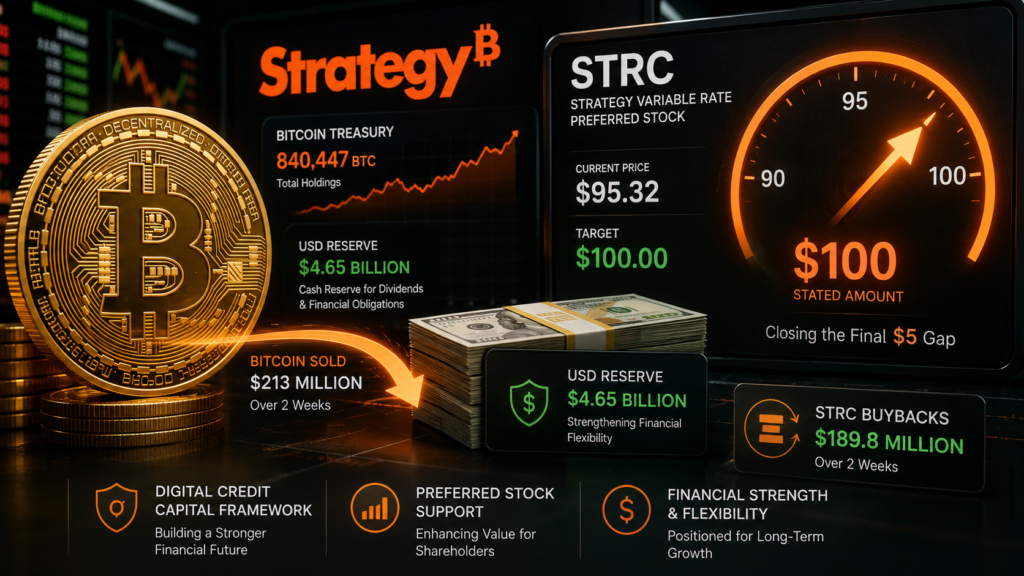
Strategy has sold about $213.3 million of Bitcoin across two weeks while directing capital toward its STRC preferred stock and a rapidly growing US dollar reserve.
The bigger story is not that Strategy has abandoned Bitcoin, it is that Bitcoin has become an active tool for managing the incre singly complex financial machine built around it.
For years, the Strategy story was remarkably easy to understand.
Raise money, Buy Bitcoin, Hold Bitcoin, Repeat.
That simple version of the Michael Saylor playbook is no longer enough to explain what Strategy is doing in 2026.
The company is still one of the world’s largest institutional holders of Bitcoin, but it is now actively moving capital between Bitcoin, common shares, preferred securities and cash reserves as it tries to keep its new financial structure working efficiently.
The latest example arrived in Strategy’s August 10 filing with the US Securities and Exchange Commission.
During the week from August 3 through August 9, Strategy sold 1,690 BTC for approximately $108.6 million, receiving an average sale price of $64,262 per Bitcoin after fees and expenses. The company said those proceeds were used to repurchase 1,152,020 shares of STRC preferred stock for the same $108.6 million.
That came only one week after Strategy sold another 1,638 BTC for roughly $104.7 million. Strategy’s own Bitcoin ledger records both transactions, taking the two-week Bitcoin sales total to about 3,328 BTC worth $213.3 million.
The headline number is big.
The more interesting question is why Strategy is doing it.
What happened in the latest Strategy filing
Strategy’s August 10 SEC filing lays out three major moves.
First, it sold 1,690 Bitcoin.
Second, it used the $108.6 million of Bitcoin sale proceeds to buy back STRC.
Third, Strategy issued another 6.59 million MSTR common shares, producing approximately $653.1 million in net proceeds. Of that amount, $650 million went into its US dollar reserve and another $3.1 million went into general cash.
That pushed Strategy’s dedicated USD Reserve to $4.65 billion as of August 9. The reserve exists specifically to help support preferred-stock dividends and interest payments on outstanding debt.
Strategy’s Bitcoin holdings fell to 840,447 BTC, acquired for an aggregate purchase price of approximately $63.36 billion and an average acquisition price of about $75,385 per Bitcoin.
The company therefore still owns an enormous Bitcoin position.
This is not a wholesale exit.
It is a change in how that Bitcoin is being used.
Strategy has now sold $213 million of Bitcoin in two weeks
The two latest weeks make that change much easier to see.
Strategy’s official ledger records a sale of 1,638 BTC reported on August 3 at an average sale price of $63,957, followed by the 1,690 BTC transaction reported August 10 at $64,262.
Together, those transactions amount to 3,328 Bitcoin and roughly $213.3 million in proceeds.
Over those same two weeks, Strategy spent approximately $189.8 million repurchasing STRC, according to the disclosed $81.2 million and $108.6 million weekly buybacks.
That is an important distinction.
Strategy is not simply selling Bitcoin because it needs ordinary operating cash.
It has explicitly created a capital framework under which Bitcoin can be monetised when management believes selling some BTC is preferable to issuing another security or when the proceeds can strengthen its preferred-stock structure.
What exactly is STRC?
STRC stands for Strategy’s Variable Rate Series A Perpetual Stretch Preferred Stock.
It trades on Nasdaq and currently carries a 12% annualised dividend rate, with cash dividends payable semi-monthly. Strategy says the rate can be reviewed and adjusted monthly.
The company has set a corporate objective of having STRC trade over time around $99 to $100, close to its $100 stated amount.
That does not mean STRC is guaranteed to be worth $100.
Strategy says exactly the opposite in its own disclosures. The market price can trade substantially below the target, the dividend can change, and dividends remain subject to declaration.
At the latest market reading available during this update, STRC was trading at approximately $95.32, putting it less than $5 below the company’s $100 stated amount.
That is where the “final $5” story comes from.
Why does Strategy care so much about getting STRC back toward $100?
Because STRC is more than another stock ticker.
It is part of Strategy’s funding machine.
When STRC trades near its $100 stated amount, Strategy has more flexibility to issue new preferred shares without offering them at a deep discount.
That matters because the regular STRC dividend is calculated against its $100 stated amount. A persistent market discount can therefore make raising new money through STRC less attractive.
Strategy’s June capital framework made its goal clear: management wants to support trading around $99 to $100 through a combination of dividend policy, liquidity reserves, security repurchases and, when appropriate, Bitcoin monetisation.
The company is essentially trying to make STRC behave more like a relatively stable income instrument despite sitting inside a corporate structure dominated by an extremely volatile asset: Bitcoin.
That is a difficult balancing act.
Strategy still has $785.2 million of buyback capacity
Strategy authorised a $1 billion Digital Credit Securities Repurchase Program on June 29.
That program can cover STRC as well as Strategy’s STRF, STRD and STRK preferred securities, although Strategy initially identified STRC as its priority when management considered repurchases attractive.
Following the latest purchases, $785.2 million of that $1 billion authorisation remains available.
This needs to be described carefully.
Strategy does not owe the market another $785.2 million in purchases.
It does not have to use the entire authorisation.
And $785.2 million is not an estimate of the amount required to push STRC from roughly $95 to $100.
It is simply the unused portion of the company’s authorised preferred-security repurchase program.
Strategy says the program has no fixed expiration date and can be modified, suspended or terminated.
The distinction matters because a dramatic headline can make it sound as though Strategy has calculated exactly how much money is required to close STRC’s remaining price gap.
It has not.
Markets do not work that neatly.
Bitcoin is now part of the capital-management toolkit
The biggest strategic change happened on June 29 when Strategy formally announced its Digital Credit Capital Framework.
The framework introduced a dedicated USD Reserve policy, a revised STRC dividend policy, preferred-stock repurchases, an MSTR common-stock repurchase authorisation and a formal Bitcoin Monetization Program.
Under that policy, Strategy’s board authorised Bitcoin sales for several defined purposes.
Those include building the USD Reserve, replenishing it after dividend and interest payments, funding preferred-stock or MSTR repurchases and covering related transaction costs when management believes selling Bitcoin makes more sense than other capital-market options.
That represents a genuine evolution in the Strategy model.
Bitcoin is still the primary treasury reserve asset.
But it is no longer treated solely as something that enters the balance sheet and never leaves.
Bitcoin can now be converted back into dollars when management believes doing so strengthens another part of the capital structure.
The $4.65 billion cash reserve may be just as important as the Bitcoin sales
Strategy’s growing cash reserve has received less attention than the Bitcoin sales, but it may be one of the most important parts of the current story.
When the framework was introduced on June 29, Strategy reported approximately $2.55 billion in its USD Reserve.
At the time, Strategy estimated its annual preferred dividends and debt-interest expense at around $1.76 billion.
By August 9, the reserve had grown to $4.65 billion.
Using that June expense run rate simply as a rough reference, that is more than two and a half years of coverage before allowing for changes in dividends, debt, future issuance, taxes or other factors.
The reserve gives Strategy breathing room.
It means every preferred dividend payment does not immediately require another stock issue or another Bitcoin sale.
It also gives holders of Strategy’s preferred securities a larger visible liquidity buffer behind recurring cash payments.
But again, the reserve is not a guarantee.
Obligations can change, dividend rates can change and market conditions can change quickly.
Strategy is selling MSTR while buying back STRC
There is another part of this story that common shareholders should not ignore.
Strategy sold approximately 6.59 million MSTR shares during the latest reporting week, raising $653.1 million.
So while Strategy was using Bitcoin proceeds to buy back preferred shares, it was simultaneously issuing additional common stock.
That creates a trade-off.
More MSTR issuance can provide Strategy with large amounts of cash without selling as much Bitcoin, but it also increases the number of common shares outstanding.
Strategy still reported roughly $22.04 billion of remaining MSTR ATM issuance capacity as of August 9.
That is a huge amount of potential funding capacity.
It also means common shareholders need to pay attention not simply to how much Bitcoin Strategy owns, but to how many shares and senior securities sit around that Bitcoin.
Strategy itself now publishes metrics designed to examine Bitcoin holdings on a per-share basis and warns that simply increasing Bitcoin holdings does not automatically mean every capital transaction is accretive to common shareholders.
This is why simply watching Strategy’s Bitcoin total is no longer enough
A few years ago, investors could largely follow Strategy by watching one number.
How much Bitcoin does it own?
That still matters.
But it no longer tells the whole story.
Investors now need to watch Bitcoin holdings, MSTR share issuance, preferred-stock issuance, preferred dividends, debt, USD Reserve levels, Bitcoin per share and the prices of Strategy’s preferred securities.
The company’s capital structure has become far more sophisticated.
That creates more tools for management.
It also creates more moving parts for investors to understand.
Is Strategy abandoning its Bitcoin strategy?
No evidence in the latest filing suggests that.
Strategy still held 840,447 BTC as of August 9, making the recent sales small relative to the overall treasury.
The company’s June framework also explicitly states that Bitcoin remains its primary treasury reserve asset.
What has changed is the absolute “Bitcoin only goes in” perception.
Management has now demonstrated repeatedly that it will sell portions of the reserve when it believes doing so improves the wider capital structure.
That is important.
Investors should no longer assume every Bitcoin purchased by Strategy will necessarily remain untouched indefinitely.
Selling Bitcoin below the portfolio’s average purchase price deserves attention
Strategy reported an average acquisition cost of approximately $75,385 per BTC across its remaining 840,447 Bitcoin as of August 9.
Its latest sale was completed at an average net sale price of $64,262.
Those figures may look uncomfortable side by side.
But they should not automatically be described as proof of a realised loss on the specific Bitcoin sold because a company’s overall average acquisition price is not necessarily the tax or accounting cost basis assigned to the particular coins disposed of.
What can safely be said is that Strategy is now willing to monetise Bitcoin even when Bitcoin trades below the average acquisition price reported for its overall remaining treasury.
That says something important about management’s priorities.
Protecting or improving the capital structure can sometimes take precedence over simply maximising the number of Bitcoin held.
The $100 STRC level remains a target, not a promise
Strategy has previously pointed out that STRC took about 70 trading days to reach par after its original 2025 launch.
In a Q2 2026 presentation, the company illustrated that repeating the same 70-trading-day recovery period from its recent low would place the $100 level around September 8.
That is useful context.
It is not a forecast investors should treat as guaranteed.
The circumstances are different now.
Strategy is actively buying STRC.
The dividend rate has been increased to 12%.
The cash reserve is considerably larger.
Bitcoin itself continues to move.
And investors are now assessing Strategy’s willingness to issue common shares and sell Bitcoin to support the wider structure.
The market will ultimately decide whether STRC reaches $100, how quickly it gets there and whether it can stay there without continued intervention.
What happens if STRC reaches $100?
If STRC moves back around its $100 stated amount and remains there, Strategy may have less reason to use Bitcoin or other capital to buy shares back.
More importantly, STRC could become a more effective capital-raising instrument again.
That would matter because Strategy has already demonstrated that preferred securities are a major part of its plan to finance Bitcoin exposure without relying entirely on conventional debt or endless common-stock issuance.
A healthy STRC market could therefore reopen another funding route.
And that may ultimately be worth more to Strategy than the few thousand Bitcoin it has recently sold.
What happens if STRC stays below $100?
This is the less comfortable scenario.
Strategy could choose to keep buying shares.
It still has $785.2 million of authorised preferred-security repurchase capacity available.
It could continue maintaining the 12% STRC dividend.
It could raise more money through MSTR.
It could sell additional Bitcoin within the framework approved by its board.
Or it could decide that further intervention no longer makes economic sense.
Strategy’s own framework deliberately leaves management with multiple choices. It does not obligate the company to use any specific one.
That flexibility is a strength.
It is also why the next few Strategy filings matter.
What investors should watch next
The first number is STRC itself.
At roughly $95.32 during the latest market reading, it has recovered much of the distance toward Strategy’s preferred $99-to-$100 zone but is not there yet.
The second number is Bitcoin.
Bitcoin was trading near $63,705 during our latest check. Continued weakness could make further BTC monetisation more politically and financially sensitive for a company whose identity remains closely tied to long-term Bitcoin ownership.
The third number is MSTR issuance.
MSTR was around $96.09 at the latest available market reading, while Strategy still had more than $22 billion of ATM capacity available.
Then there is the USD Reserve.
At $4.65 billion, it gives Strategy substantially more flexibility than it had only a few months ago.
Put those pieces together and the next phase of Strategy becomes much more interesting than simply asking whether Michael Saylor will buy more Bitcoin on Monday.
The bigger Strategy story has changed
Strategy spent years proving that a public company could turn its balance sheet into a leveraged Bitcoin strategy.
Now it is trying to prove something different.
Can that Bitcoin treasury support an entire family of financial products through multiple market cycles?
STRC is an important test.
If Strategy can restore the preferred stock near its $100 stated amount, maintain investor demand, keep dividend liquidity comfortable and continue managing Bitcoin exposure without excessive common-stock dilution, its Digital Credit strategy gains credibility.
If it requires repeated Bitcoin sales, increasingly expensive dividends or heavy MSTR issuance just to keep the system stable, investors may begin asking harder questions about how scalable the model really is.
That is why the last $5 matters.
Not because $100 is a magical number.
But because STRC’s behaviour may tell us whether Strategy’s next-generation financing machine works as intended when markets stop cooperating.
Final assessment
The headline sounds almost contradictory.
Strategy is selling Bitcoin to strengthen a financial structure designed around Bitcoin.
But that is exactly what its new capital framework allows.
The company sold roughly $213.3 million of Bitcoin over two weeks, repurchased nearly $190 million of STRC during the same period, increased its USD Reserve to $4.65 billion and continued issuing MSTR common stock.
Strategy still owns more than 840,000 BTC.
So this is not the end of the Saylor Bitcoin strategy.
It is the beginning of a more complicated version of it.
Bitcoin is now not merely the asset Strategy accumulates.
It is collateral in the broad economic sense, treasury capital, a reserve asset and, when management decides the numbers work, a source of liquidity.
Whether that makes Strategy stronger or simply more complex will become clearer as STRC makes its next move.
For now, the market is watching that final stretch toward $100.
And Strategy still has plenty of tools left if it decides to push.
Frequently asked questions
How much Bitcoin did Strategy sell?
Strategy sold 1,690 BTC for approximately $108.6 million during August 3 to August 9. Together with the 1,638 BTC sale reported the previous week, Strategy sold about 3,328 BTC for $213.3 million across two weeks.
How much Bitcoin does Strategy still own?
As of August 9, 2026, Strategy reported holdings of 840,447 BTC acquired for an aggregate purchase price of approximately $63.36 billion, or an average of roughly $75,385 per Bitcoin.
What is STRC?
STRC is Strategy’s Variable Rate Series A Perpetual Stretch Preferred Stock. It currently carries a 12% annualised dividend rate payable semi-monthly, with the rate subject to monthly adjustment. Strategy’s stated objective is for STRC to trade around $99 to $100 over time.
Does Strategy need to spend another $785 million to get STRC to $100?
No. $785.2 million is simply the remaining authorised capacity under Strategy’s $1 billion Digital Credit Securities Repurchase Program. Strategy is not required to use it, and the company has not said $785.2 million is necessary to move STRC to $100.
Is Strategy abandoning Bitcoin?
No. Strategy continues to state that Bitcoin is its primary treasury reserve asset and still owns more than 840,000 BTC. What has changed is that its board now permits Bitcoin monetisation for defined capital-management purposes including preferred-security repurchases, reserve funding and certain financial obligations.
Is STRC guaranteed to reach $100?
No. Strategy explicitly warns that STRC’s market price can trade below its desired range and that there is no guarantee it will trade at $99, $100 or any other particular price.
Official links and social channels
Strategy: https://www.strategy.com/
Strategy investor relations: https://www.strategy.com/investor-relations
Strategy Bitcoin ledger: https://www.strategy.com/ledger
STRC information: https://www.strategy.com/strc/learn
Strategy on X: https://x.com/Strategy
Strategy on YouTube: https://www.youtube.com/@strategysoftware
Strategy’s current investor communications confirm the X and YouTube channels above as its official channels for live investor events.
Sources
US SEC Strategy Form 8-K, August 10, 2026: Latest Bitcoin sale, MSTR issuance, STRC repurchase, Bitcoin holdings and $4.65 billion USD Reserve.
Strategy Digital Credit Capital Framework, June 29, 2026: STRC target, repurchase authorisations, USD Reserve policy and Bitcoin Monetization Program.
Strategy STRC information: Current structure, 12% variable dividend policy, stated amount and investment disclosures.
Strategy Bitcoin Ledger: Historical Bitcoin acquisitions and 2026 Bitcoin sales.
CryptoSlate original report: Strategy has $785 million left to close STRC’s final $5 gap after selling $213 million in Bitcoin.