Ambulance Tasmania Deploys Robotic CPR Machines Across Five Stations
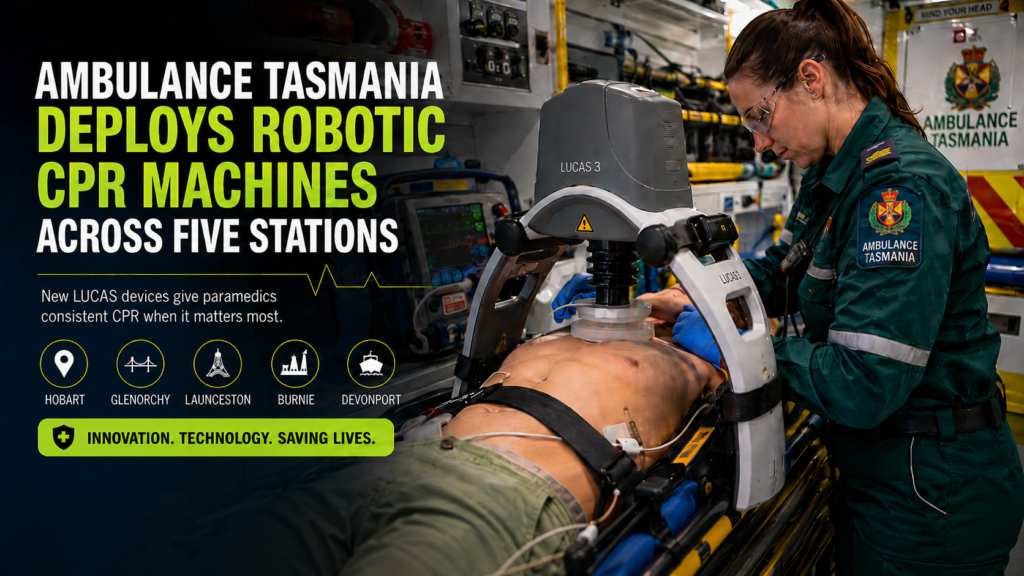
Ambulance Tasmania is rolling out LUCAS mechanical CPR machines across five stations, helping paramedics deliver consistent chest compressions while focusing on other critical emergency care.
Ambulance Tasmania is rolling out five new LUCAS mechanical CPR devices across Tasmania, giving Intensive Care Paramedics access to automated chest compressions during cardiac-arrest emergencies. The devices will be based in Hobart, Glenorchy, Launceston, Burnie and Devonport.
The technology is designed to perform continuous chest compressions at a controlled rate and depth while paramedics concentrate on other critical parts of a patient’s treatment.
It is a good example of technology being used not to replace skilled emergency workers, but to support them when every second counts.
Where will Tasmania’s new CPR machines be located?
Five LUCAS mechanical CPR devices are being introduced across the state.
The rollout includes:
Hobart – one device
Glenorchy – one device
Launceston – one device
Burnie – one device
Devonport – one device
That gives southern, northern and north-west Tasmania access to the new equipment, with all five devices allocated to Intensive Care Paramedics.
Ambulance Tasmania already has three LUCAS devices operating within its Critical Care and Retrieval service, meaning the latest rollout will significantly broaden access to the technology.
What is a LUCAS CPR machine?
A LUCAS chest compression system is a portable mechanical device that performs automated chest compressions on a patient experiencing cardiac arrest.
Instead of a paramedic having to continually perform manual chest compressions, the device is positioned around the patient’s chest and mechanically performs the compressions.
Manufacturer Stryker says the system is designed to deliver consistent chest compressions at a controlled depth and rate, while allowing medical teams to concentrate on other interventions.
Although the machines are sometimes described as “robotic CPR machines”, they do not replace paramedics or make medical decisions.
They perform one demanding physical component of resuscitation while trained medical professionals remain responsible for the patient’s overall care.
Why could mechanical CPR be valuable for Tasmanian paramedics?
CPR is physically demanding.
Ambulance Tasmania chief executive Nicole Ashworth said fatigue can begin affecting the performance of manual CPR after only a short period.
Mechanical chest compression devices can continue providing compressions at a fixed rate and depth without becoming physically tired.
This can be particularly useful when an Intensive Care Paramedic is responding alone.
While the device continues CPR, the paramedic can potentially concentrate on other critical tasks such as airway management, monitoring, medication, defibrillation and treating the cause of the cardiac arrest.
It is an important distinction.
The machine performs the repetitive physical work. The paramedic provides the knowledge, judgement and medical care.
That combination of human expertise and specialised technology may be where some of the biggest benefits of automation in healthcare are found.
Technology supporting paramedics rather than replacing them
The arrival of automated CPR technology also highlights a wider conversation taking place across many industries.
As robotics and artificial intelligence become more capable, there is understandable concern about technology replacing people.
Emergency medicine demonstrates another possibility.
A machine can be extremely good at performing a repetitive task consistently, while the human professional remains responsible for judgement, adaptation, communication and complex decision-making.
A mechanical CPR machine cannot reassure a frightened family.
It cannot independently assess the entire emergency scene.
It cannot determine every treatment a patient requires.
But it can repeatedly perform chest compressions while a trained paramedic uses their skills elsewhere.
That is technology being used as a tool for people, rather than simply as a replacement for people.
Tasmania already has experience using LUCAS devices
The technology is not completely new to Ambulance Tasmania.
Three LUCAS devices are already used within the Critical Care and Retrieval service, and one was used during the major Franklin River rescue operation.
The November 2024 Franklin River rescue involved an extremely difficult and prolonged emergency response in remote south-west Tasmania, demonstrating the complex environments in which Tasmanian emergency personnel sometimes operate.
For a state with remote communities, long transport distances, difficult terrain and isolated emergency locations, portable medical technology can potentially have particular value.
Paramedics are being trained before the rollout
The new equipment will not simply be placed into ambulances immediately.
Intensive Care Paramedics are undergoing specialist training with education staff from manufacturer Stryker before the devices enter operational service.
The five new machines are expected to be introduced progressively over the coming months once that training is completed.
Ambulance Tasmania has also indicated that it intends to continue expanding the use of mechanical CPR technology across its fleet.
A practical example of human skills plus technology
There is sometimes a tendency to frame new technology as a competition between machines and people.
Healthcare provides a much better model.
The value of a device such as LUCAS is not that it eliminates the need for a highly skilled paramedic.
Its value is that it can take over one exhausting, repetitive physical task while allowing that paramedic to use their training and experience where they are needed most.
Technology handles the repetition. People provide the judgement, experience and care.
For Tasmanians experiencing one of the most serious medical emergencies possible, that combination could become an increasingly important part of frontline emergency medicine.
Frequently Asked Questions
What are the new robotic CPR machines being introduced in Tasmania?
They are LUCAS mechanical chest compression devices designed to automatically provide consistent chest compressions to patients experiencing cardiac arrest.
How many new CPR machines is Ambulance Tasmania introducing?
Ambulance Tasmania is introducing five new devices.
Which Tasmanian ambulance stations will receive them?
The devices will be based at Hobart, Glenorchy, Launceston, Burnie and Devonport.
Will robotic CPR machines replace paramedics?
No. The devices perform mechanical chest compressions. Paramedics remain responsible for assessment, treatment and clinical decision-making.
Why use mechanical CPR instead of manual CPR?
Manual CPR is physically demanding and can be affected by responder fatigue. Mechanical systems can provide repeatable chest compressions while medical personnel concentrate on other aspects of resuscitation.
Does Ambulance Tasmania already use LUCAS machines?
Yes. Ambulance Tasmania already operates three LUCAS devices through its Critical Care and Retrieval service.
When will the new machines enter service?
The new devices are expected to be progressively deployed after Intensive Care Paramedics complete specialist training.
Source and attribution: This article is independently written from information released by Tasmania’s Department of Health, reporting by Pulse Tasmania and technical information about the LUCAS system from manufacturer Stryker.