DeFi Development Shuts Treasury Accelerator After $27.3M Q2 Loss
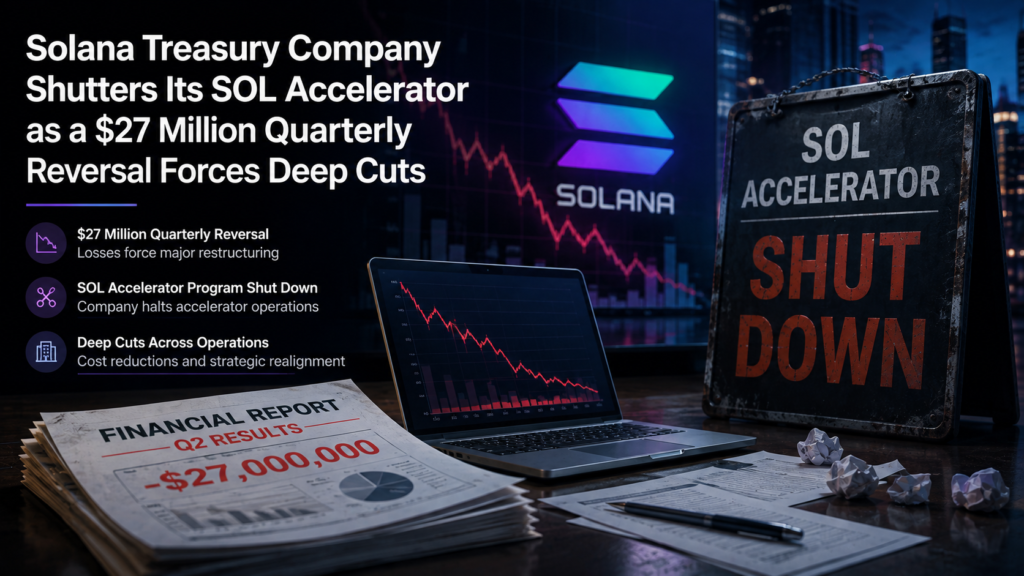
DeFi Development Corp has stopped new Treasury Accelerator deals after reporting a $27.3 million Q2 2026 loss while maintaining its Solana treasury strategy
DeFi Development Corp has stopped making new investments through its Treasury Accelerator after reporting a $27.3 million net loss for the second quarter of 2026. The Solana-focused treasury company is cutting costs, simplifying its DeFi strategy and restructuring its financing but it is not abandoning SOL or immediately liquidating its existing accelerator investments.
The move marks a significant change for the Nasdaq-listed company as it attempts to navigate weaker crypto markets while maintaining its central objective: increasing the amount of Solana represented by each company share.
What happened to DeFi Development Corp in Q2 2026?
DeFi Development Corp, trading under the Nasdaq ticker DFDV, reported a $27.287 million net loss for Q2 2026, compared with net income of $15.432 million during the same quarter a year earlier.
One of the biggest contributors was the company’s digital-asset portfolio.
DFDV recorded a $21.519 million net loss on digital assets, reversing a $21.194 million gain in Q2 2025.
However, revenue increased.
Total quarterly revenue reached $3.314 million, up 66.9% year over year, while Digital Asset Treasury revenue rose to $3.256 million, an increase of 170.1%.
Operating expenses and cost of goods sold, excluding fair-value changes, fell 22.6% to $4.635 million.
This means the $27.3 million headline loss should not simply be interpreted as $27.3 million of cash being spent by the business. Changes in the valuation of its digital assets played a major role in the reported result.
Why is DeFi Development shutting the Treasury Accelerator?
DFDV says it is shuttering the Treasury Accelerator program and will not originate additional Treasury Accelerator transactions.
The program had been designed to allow DFDV to invest in other digital-asset treasury opportunities.
Management says the strategy demonstrated that these investments could potentially add value, but it also created less visible costs particularly management attention and additional communication complexity.
The company now wants to return its focus to what it describes as its core identity:
leveraged exposure to Solana with the goal of increasing SOL per share.
Importantly, shutting the program does not mean all existing investments are being immediately sold.
DFDV says its existing positions, including investments in ZeroStack and Allied Architects, will continue to be managed and may be monetized when management considers the timing appropriate.
Is DeFi Development Corp abandoning Solana?
No.
If anything, the company is trying to make its business more directly focused on Solana.
As of August 12, 2026, DeFi Development reported holdings of 2,311,523 SOL and SOL equivalents.
Against 35.3 million fully converted shares, the company reported fully converted SOL per share of 0.066, approximately 24% higher than the 0.053 reported a year earlier.
Management has made it clear that SOL remains its primary treasury asset.
The company therefore appears to be cutting away activities it believes distract from its main Solana treasury strategy rather than retreating from SOL itself.
DFDV is also simplifying its DeFi strategy
The Treasury Accelerator is only one part of the restructuring.
DFDV is reducing the number of decentralized-finance protocols and strategies in which it participates.
During the previous year, the company spread SOL across numerous protocols and participated in partnerships with newer projects.
Management says the economics have changed.
With yields lower, the additional returns available from smaller or more experimental strategies may no longer compensate for their smart-contract and counterparty risks.
DFDV says its on-chain activity will now be concentrated largely around established Solana platforms and strategies involving:
Kamino
JupLend
Sanctum
dfdvSOL
The company says staked-SOL looping remains an important part of its strategy.
So DFDV is not abandoning DeFi.
It is reducing the number of places where it puts its capital.
Debt buybacks could help DFDV simplify its balance sheet
The company is also buying back some of its convertible debt at prices below face value.
Since its previous shareholder update, DFDV repurchased approximately $3.5 million in principal of its July 2030 convertible notes for $2.3 million in cash.
That represents a discount of roughly 35%.
In total, the company says it has now repurchased approximately $7.9 million of principal for $5 million.
DFDV estimates those cumulative repurchases will reduce annual interest expenses by more than $400,000.
Buying debt below face value can be beneficial because the company removes more debt from its balance sheet than the amount of cash required to buy it back.
Management says it expects to continue considering debt repurchases when market prices make them attractive.
DFDV is also issuing shares to pay operating costs
There is another side to the restructuring.
Beginning in late June, DFDV issued approximately 478,000 shares through its at-the-market facility, raising around $1.4 million.
The money was used to fund cash operating expenses.
Management estimated that the additional shares reduced SOL per share by around 1.4%.
That presents investors with an important trade-off.
DFDV could sell some of the SOL generated through staking and treasury activities to cover expenses.
Instead, management currently wants that SOL to remain inside the treasury and continue compounding.
The company is therefore using cash and share issuance to help cover operating costs.
But issuing more shares dilutes existing shareholders.
It means investors should not look only at how much SOL the company owns.
They should also watch how much SOL is represented by each share.
Falling SOL prices changed the equation
DFDV says SOL declined by more than 20% following its Q1 results, while staking rates also compressed.
That reduced the amount of income generated by the company’s treasury relative to its expenses.
DFDV entered Q2 with approximately $27 million in annual cash costs, including roughly $17 million in annualised operating expenses and around $10 million in interest expenses across its financing arrangements.
Historically, management says its organic treasury yield covered most of those expenses.
Lower SOL prices and staking yields changed that calculation.
The company is now attempting to lower its costs while preserving more of the SOL generated by its treasury operations.
How much debt does DeFi Development have?
Leverage remains one of the biggest risks surrounding DFDV.
As of August 12, 2026, the company reported:
Total debt to market capitalisation: 216%
Net debt to assets: 98%
Net debt to SOL and SOL equivalents: 104%
Those are significant leverage levels.
Management says simplifying the company’s capital structure remains a priority and that it expects to rely less on convertible and other senior debt instruments over time.
Preferred equity is one possible financing tool the company has identified.
This is an important distinction for anyone evaluating DFDV.
It isn’t simply a company that buys and holds Solana.
It is attempting to use corporate financing, leverage, staking and capital-market strategies to increase SOL per share.
That potentially magnifies gains when conditions are favourable.
It can also magnify financial risk when crypto markets weaken.
More cost cuts are expected
DFDV says a considerable amount of its previous spending was associated with building its Solana treasury business.
That included legal, accounting and advisory expenses as well as spending associated with projects such as the Treasury Accelerator.
With much of that initial work completed and the accelerator closed to new transactions, management expects operating expenses to fall again beginning in Q3.
The company is also consolidating third-party providers and automating repetitive internal processes.
These include areas such as treasury monitoring, reporting, research production and investor-communications infrastructure.
The objective is to operate the Solana treasury with a considerably leaner corporate structure.
DFDV keeps its long-term SOL-per-share goal
DFDV has decided not to issue its previously anticipated June 2027 SOL-per-share guidance.
Management says market conditions make shorter-term forecasting too uncertain and could create a false sense of precision.
However, the company’s longer-term goal remains unchanged.
DFDV is still targeting 1.0 SOL per share by December 2028.
That target assumes what management describes as a constructive cryptocurrency environment during 2027 and 2028.
It is an ambitious target.
The company’s fully converted SOL-per-share figure was 0.066 as of August 12, 2026.
What does the Treasury Accelerator shutdown really mean?
The most accurate way to describe the change is strategic consolidation.
DFDV experimented with a wider range of investments, partnerships and DeFi strategies during the expansion of its Solana treasury business.
It is now narrowing those activities.
The company’s strategy increasingly comes down to four priorities:
Accumulate and compound SOL
Increase SOL per share
Reduce operating costs
Simplify its financing and balance sheet
The Treasury Accelerator became expendable because management believed it distracted from those priorities.
What investors should watch next
Several numbers could now become particularly important for DFDV investors.
The first is SOL per share.
Increasing the company’s overall SOL holdings may mean much less if the number of shares outstanding rises even faster.
The second is debt.
Buying convertible notes below face value could improve DFDV’s financial position, but leverage remains substantial.
The third is operating cost.
If management delivers the expected Q3 cost reductions, less money will be required simply to run the corporate structure.
And finally, there is the price and staking yield of SOL itself.
DFDV’s model remains heavily exposed to Solana.
If SOL prices and network yields recover, the economics of the treasury strategy could improve significantly.
If weakness continues, debt, dilution and financing costs become increasingly important.
Why this matters beyond DFDV
The results provide a useful test for the rapidly expanding digital asset treasury sector.
Holding cryptocurrency on a corporate balance sheet can appear extremely attractive during a rising market.
The harder test arrives when token prices decline.
DFDV still held more than 2.31 million SOL and SOL equivalents and reported approximately 24% year-over-year growth in fully converted SOL per share.
At the same time, it reported a $27.3 million quarterly loss, issued shares to help fund operating expenses and ended a major expansion initiative.
That illustrates why investors analysing crypto treasury companies need to look beyond the headline number of tokens held.
Crypto per share, debt, dilution, operating expenses and financing costs can matter just as much as the treasury balance itself.
Frequently Asked Questions
Why did DeFi Development Corp close its Treasury Accelerator?
DFDV says the program added management and communication complexity and distracted from its core objective of increasing SOL per share. The company will no longer originate new Treasury Accelerator transactions.
Did DeFi Development Corp lose $27 million?
Yes. DFDV reported a $27.287 million net loss for Q2 2026. A $21.519 million net loss on digital assets was a major contributor to the quarterly result.
Is DeFi Development selling all of its Solana?
No. SOL remains the company’s primary treasury asset. DFDV reported 2,311,523 SOL and SOL equivalents as of August 12, 2026.
Has the Treasury Accelerator been completely liquidated?
No. New transactions have stopped, but existing investments including ZeroStack and Allied Architects remain. DFDV says they will be managed and monetized when appropriate.
How much SOL does DFDV have per share?
DFDV reported fully converted SOL per share of 0.066 as of August 12, 2026, approximately 24% higher than a year earlier.
Why is DFDV issuing new shares?
The company has been using its at-the-market share facility to help meet cash operating costs while allowing SOL generated by treasury operations to remain in its treasury.
What is DFDV’s long-term SOL target?
Management continues to target 1.0 SOL per share by December 2028, although it has stopped providing shorter-term June 2027 guidance.
Is DeFi Development Corp shutting down?
No. The company is shutting the Treasury Accelerator to new transactions and simplifying its operations. Its primary Solana treasury strategy remains active.
Is this financial advice?
No. This article is for news and informational purposes only. Cryptocurrency and crypto-related equities can be highly volatile. Readers should conduct their own research before making financial decisions.
Source note: This article was independently written using DeFi Development Corp’s Q2 2026 shareholder letter filed with the U.S. Securities and Exchange Commission, together with reporting from CryptoSlate.